

A few years ago, I embarked on a journey that felt a bit like learning a new language in a country I already lived in. I enrolled in the University of Michigan’s Applied Data Science Masters program.
As someone who has spent their career in the heart of Silicon Valley, I’ve always been “tech-adjacent.” I thought I understood complex problems. But this journey was deeper. It wasn’t just about learning tools; it was about learning how Data Scientists think.
I realized that while everyone talks about “AI” as a buzzword, very few understand the engine under the hood. In a world being reshaped by algorithms, understanding Data Science isn’t just for practitioners—it’s a necessary survival skill for the modern professional.
Defining the Layers: AI vs. ML vs. Data Science
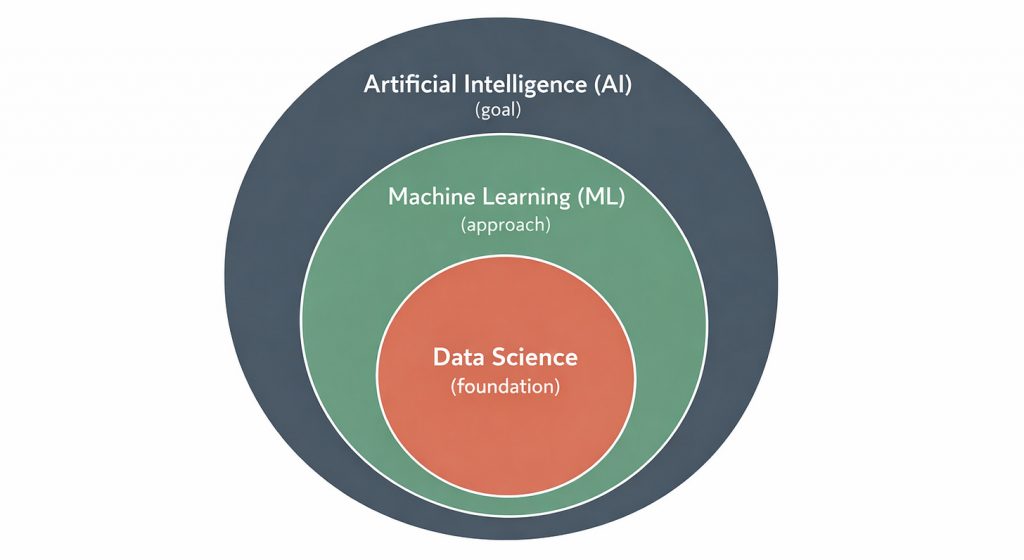
To understand how AI works, you have to understand what Data Science is, because it provides the underlying foundation and methods in which AI models are created and evolve.
If you think of this technology as a system, the hierarchy of the AI “brain” we are building is a construct that includes three distinct layers:
- Artificial Intelligence (AI): The overarching goal. It’s the quest to create machines that perform tasks requiring human-like intelligence—reasoning, recognizing faces, or making decisions.
- Machine Learning (ML): A specific approach within AI. Instead of hand-coding every rule, we give the system data and let it “learn” the patterns itself. Think of ML like teaching a child to recognize a dog by showing them a thousand pictures of dogs, rather than writing a 500-page manual on “What Makes a Dog.”
- Data Science: The foundation. It is the practice of collecting, cleaning, and interpreting the “fuel” (data) that makes ML and AI possible.
From Raw Ingredients to the Perfect Dish
To truly see how these layers interact, let’s look at them through the lens of a world-class restaurant. If we reverse-engineer the final experience, the hierarchy becomes clear:
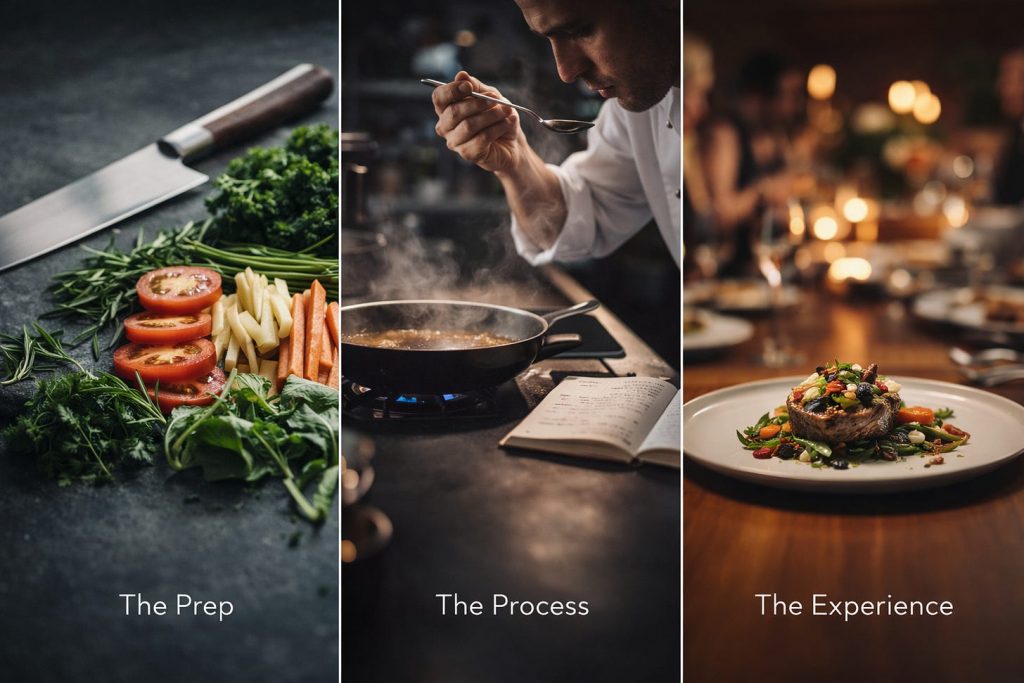
- Artificial Intelligence is the Final Dish: It is the intelligently balanced meal placed in front of the guest. The guest doesn’t see the kitchen; they simply experience the “intelligent” result.
- Machine Learning is the Head Chef: This is the “brain” of the kitchen—the process of creating and perfecting the recipe, tasting the sauce, realizing what’s missing, and adjusting until it’s right.
- Data Science is the Ingredients and the Tools: This is the foundation—the fresh produce and the sharp knives. If the ingredients are rotten, the meal fails, no matter how talented the chef is.
The Golden Rule: Data Science makes Artificial Intelligence possible.
The Cooking Experience: A Narrative
Now, imagine you are in your own kitchen, preparing a landmark meal for people you care about. To get to that “AI” moment, you have to move through the process from the ground up.
Data Science is the Prep Work. Before the stove is even lit, you have to source your materials. You are at the market selecting the freshest produce, then heading home to sharpen your knives and organize your workspace. In the tech world, this is the essential, often manual labor of gathering and refining “raw data” so it is actually usable. Without this meticulous prep, your “meal” is doomed before it starts.
Machine Learning is the Recipe and the Tasting. Now, you start cooking. You follow a recipe, but you don’t just “set it and forget it.” You taste the sauce, add a pinch of salt, turn down the heat, and try again. You are iteratively refining the process to get closer to a perfect outcome. This is Machine Learning: the system “tastes” the data over and over, identifying patterns and adjusting its internal settings—its “volume knobs”—until it finds the ideal balance.
Artificial Intelligence is the Dinner Party. Finally, the guests arrive. They don’t see the messy kitchen, the discarded vegetable peels, or the failed first attempts. They simply experience the “intelligence” of the finished product. This is AI—the moment the technology steps out of the back-of-house and into the world to solve a problem, make a decision, or spark a conversation.
AI in Your Pocket: Real-World Impacts
You are already interacting with this “kitchen” every day, often without realizing it:
- The Amazon “Nudge”: When you see “Customers who bought this also bought…” on Amazon or another e-commerce site, that’s a Recommender System. It’s like a waiter who remembers every meal you’ve ever ordered and suggests a wine pairing you didn’t know you wanted.
- The Invisible Translator: When you use Google Translate, the system isn’t just swapping words. It’s using Deep Learning (a more complex version of Machine Learning that mimics the layers of the human brain) to understand the intent and context of your sentence.
- The Self-Driving Commute: When a Waymo navigates a street, it uses sensors to “see” the world. It’s processing millions of scenarios simultaneously to predict what a pedestrian might do next.
Looking to the Future: The Advantage of the Informed
Technological shifts have always disrupted civilizations, but AI is unique because it scales human intuition. We are currently in a window of time where we can choose to either resist this shift or seek to understand the mechanics behind it.
You don’t need to be the one writing the code, but in a world being reshaped by these algorithms, you do need to be the one who understands how the ingredients lead to the result. In the emerging AI economy, the greatest advantage isn’t technical skill—it is the ability to bridge the gap between human needs and machine outputs.
I want to hear from you: What is the one thing about AI that still feels like “magic” (or a mystery) to you? Drop a comment below. I’m using your questions to shape the next few deep-dives of this blog.